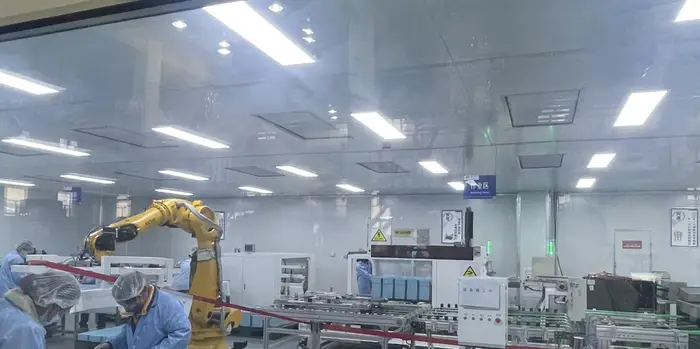







Class 100 Clean Area:Key to Aseptic Cold Filling of Juice
Equally critical is compatibility between ceiling structure and modular architecture. The cleanroom T grid must integrate seamlessly with both structural supports and service chases—especially when utilities (compressed air, CIP lines, data conduits) run overhead.
Why Juice Aseptic Filling Demands Class 100 Cleanroom Integrity
For aerospace-grade cleanroom engineers specifying facilities for high-value aseptic beverage production, juice cold filling isn’t just about hygiene—it’s about particle control at the Class 100 level (≤100 particles ≥0.5 µm per cubic foot). Unlike pharmaceutical or biotech applications where sterilization dominates, cold-filled juice relies entirely on environmental containment: no thermal kill step means zero margin for airborne microbial or particulate contamination during filling. That shifts the engineering priority squarely to structural integrity, airflow uniformity, and rapid deployability—especially when scaling across regional bottling hubs.
This is where modular clean room panels prove indispensable. Prefabricated, ISO-compliant wall and ceiling systems cut on-site labor by up to 40%, while delivering consistent surface finish, leak-tight joints, and seamless integration with HVAC and monitoring infrastructure. For fast-track juice facilities facing tight seasonal launch windows, these panels aren’t a convenience—they’re a schedule enabler. And because juice lines often require frequent reconfiguration (e.g., flavor changeovers or capacity upgrades), the repeatability and traceability of certified cleanroom panel batches matter more than ever.

FFU Integration & Ceiling Grid Precision: The Hidden Enablers
Class 100 performance hinges not only on wall construction—but on how air enters, distributes, and exits the fill zone. That’s why the cleanroom ceiling grid system must support true unidirectional airflow without turbulence or dead zones. Our projects consistently specify FFU T grid configurations—engineered to accept fan-filter units with ±1% face velocity tolerance across the entire ceiling plane. This isn’t generic “T-grid” hardware; it’s load-rated, laser-aligned, and pre-drilled for gasketed FFU mounting—ensuring zero bypass leakage at the interface.
Equally critical is compatibility between ceiling structure and modular architecture. The cleanroom T grid must integrate seamlessly with both structural supports and service chases—especially when utilities (compressed air, CIP lines, data conduits) run overhead. We’ve seen too many retrofits fail due to mismatched grid spacing or underspecified load capacity. That’s why leading juice OEMs now specify full-system validation—including cleanroom ceiling grid deflection testing under FFU weight + filter loading—before panel fabrication begins.
For teams evaluating turnkey solutions, our modular laboratory buildings platform delivers fully engineered, pre-validated cleanroom shells—including integrated ceiling grids, FFU-ready framing, and certified panel assemblies—all designed for rapid deployment in food-grade environments.